Showing posts with label RED Komodo. Show all posts

5.21.2026

Devon Thompson - Pillory music video


I recently shot a low budget music video that just came out. The premise was simple: a Blair Witch style "found footage" video of a woman being chased through the woods. With that in mind, we utilized a mix of cameras, from a RED Komodo with Dulens Mini Primes (daytime) and a Sony ZV-E1 with G-Master primes on a gimbal (night), to a Sony Handycam for an especially low-fi look.

The whole crew was the director, myself, and a friend of the artist to help carry a few things. For the nighttime shots, I embraced that found footage aesthetic and primarily used a camera mounted light or car headlights (in the road shots). I had planned on using a couple sources to add some "moonlight" to the forest at night, but the director wanted it to fall off into darkness and, hey, my job is to give the director what they want and so that's exactly what I did.

You can see the music video here:


We also shot some late daytime stuff that was supposed to transition us into night, but it didn't make the edit. I think it was some of the better stuff we shot, but I guess they decided that part of the story didn't work once they got into post. Anyway, here are a few grabs from the unused footage.


10.02.2024

iHeartRadio AMA - Alice the G00n

I recently shot a little AMA for iHeart Radio and Alice the G00n. We referenced the lighting for a particular scene in a movie (which, to play it safe, I won't name since it'll tie in to the next music video) which had a harder light, under-lit look. I started off with quite a bit softer light and the producer kept saying, "It's too soft!" so I obliged with a more direct lighting style because I like to make my clients happy. And it more closely matched the reference this way. 

Recently, I picked up a set of Dulens APO mini primes and I put them to use on this shoot. They have a little more vintage look, with some softness taking the edge off the digital sensor and leaning a little towards the warmer side. It was just a crew of the producer (who also ran audio), Alice and myself. Since the main camera, a RED Komodo, was a locked off wide, I brought my Sony ZV-E1 as well to operate as a medium tight B-cam so that they would have the ability to edit without having jump cuts. I often use my Sony as a B-Cam, mostly for slow-motion work, so this was my first time using it as a second angle. For being a "blogger" camera, it looks really nice. Side note, the ZV-E1 has the same full frame sensor as the very popular FX3.


8.16.2024

In Time music video

This is another Alice the g00n music video, called In Time. Since Alice writes, directs, and edits her own music videos, it's a great collaboration as I only need to go to one source to answer most of my questions! Unlike the previous music video, which had a ton of green screen and post FX, this one was shot almost entirely on a stage with an LED wall, so the FX work was primarily done in camera. It was also an interesting one to shoot, as the entire video basically takes place inside a car, so that we had a lot of conversations about how to shoot it while spending a bunch of time in a tiny space.

Once again, I shot with the RED Komodo, as it packs a lot into a very tiny body, which is very helpful when space it tight. For glass, I went with the Sigma Cine primes as they fit the budget, are fast, and, again, are compact. I do find them a tad too sharp for the look I wanted, so I used Tokina Black Alchemy diffusion filters in the Bright Tangerine Atom matte box (again, nice and tiny).

We started the day shooting in the trunk of the car before moving on to some daylight shots, then the car moves into a 2001: A Space Odyssey style slit scan tunnel. I utilized the LED wall as much as possible as a light source, supplementing with a key light (Vortex through an 8x8 - size limited by the low ceilings in the stage) and an LED back light to create some hard "sunlight" coming in the window as well as filling in a bit of the interior.

For the tunnel, I relied mostly on Astera Titan tubes with colored pixel animations to create moving light as the car whizzes down the tunnel. I also lit the car interior with an additional solid Titan coming in through the sunroof, giving me a bit of ambience at all times.

My lighting diagram (for the daytime scenes) I drew from the location scout photos. This is pretty much exactly what we did on the day.

The lighting setup for the tunnel driving.


You can see the completed music video here:

5.24.2024

Secret Gospel

Secret Gospel, a short horror/suspense film I shot last year, has debuted on Japanese streaming platform Samansa, which makes sense as the financiers behind it are Japanese. It was written and directed by Brandon Aumen, a friend I've known for many years and we've wanted to collaborate on a project, but never matched up until this one.

We shot this over the course of 4 days with two primary locations: the convent and the main character's home. Our camera rental budget was super tight and I needed fast lenses for the nighttime and dungeon scenes, so went with Sigma Cine primes. The Sigmas were a bit too sharp for my taste, so Tokina was nice enough to lend me a set of their Black Alchemy diffusion filters to try out (I bought some after using them on this shoot and liking them so much) and they helped to take the edge off the image. We shot with my RED Komodo 6K at a 1.9:1 aspect ratio, as we wanted a little wider than the 16:9 look but not quite an anamorphic 2.4:1, which would take a little too much off the top and bottom.

For lighting, we utilized mostly Aputure LEDs, such as the 300X, 600X, and B7C. For tubes, we went with the tried and true Astera Titan Tubes. I tried to utilize sunlight where possible, as I'm a fan of natural light. While this is a modern day film, I went for a little less saturated, slightly warmer color palette to give it a more timeless visual aspect. If it weren't for the laptop and car giving away the era, I feel like this could have taken place in the 70s.

So I'll just leave you with some non-spoiler screenshots from the film.


4.14.2024

CYA music video

I recently shot a music video for Alice the g00n, called CYA. It was a studio shoot that was incredibly VFX heavy, which is always a concern on a moderate budget. In this case, I had to rely heavily upon very specific storyboards and framing to keep the amount of VFX work in check (framing shots to keep us off what would be a CG background as much as possible). Since she's both directing and editing the video, Alice had a very dialed in vision for exactly how the edit would work and what framing would be, so I have a lot less work picking shots than I'm used to. But at the end of the day, I'm there to deliver on the director's vision where keeping communication lines clear and working to the plan is very important so the VFX budget doesn't get blown up.

For the project, we shot on Atlas Orion anamorphic lenses on RED Komodo @ 6k. I didn't use any diffusion filtration to keep things as sharp as possible to help post with their background replacement. The director wanted a Lady Snowblood inspired look, which was fairly low contrast.


3.19.2024

Call Me Kat plates

Worked a couple jobs recently for Call Me Kat. One was some driving plates at night. Single camera (RED Gemini for it's great low light and high ISO abilities) using the Sigma 14mm on a Ronin 2. Pretty much the go-to setup for our driving shots. The other shoots was a bit different, as they wanted some ~180° plates (from a tripod). For this we used 3 RED Komodos, with the outer cameras positioned 45° off of the center camera. Again, we utilized the Sigma 14mm for its wide field of view. This gave us good overlap between the cameras while also seeing a lot of real estate.

To trigger all three cameras at the same time, I utilized the Tilta Nucleus, with each motor (1 per camera with a run/stop cable) set to the same channel so all three would trigger off of a single hand unit. Normally I would also mount the motor to be functional on the camera (controlling the iris so all three would match), but due to not having a prep and how the cameras had to be mounted, we had to remove the iris rods to make the cameras fit on the plate, so the motors couldn't be mounted to control iris or focus. I thought that might be the case beforehand, but wasn't worried since all the cameras were easily accessible and I could set the iris and focus by hand.

I do enjoy doing some of these less common rigs. Like I said, we didn't have a prep but I planned ahead of time to make it work with as few hitches as possible and except for not being able to mount iris rods, everything worked as expected, though there were some paper-thin clearances between cameras! I have a few ideas for next time to make things even more efficient and simple, so hopefully more of these camera array jobs come up!

Setting up for night driving plates.

Triple Komodo array with cameras set to 45° increments.

8.05.2022

RED Komodo in the house


Well, it's going on about a year and a half since I got my Komodo, and I've been using it on a variety of shoots, including as a b-cam to an Alexa Mini LF for a large FCA series of commercials, driving and location plates for a bunch of TV shows, and lots of commercial and product spots. I really like this small form factor (which makes the Alexa Mini feel huge!) and how it sips batteries. It's lightweight enough that I can toss it on a small DJI RS 2 gimbal and fly it around. No need for a giant Ronin 2 or Mōvi Pro all the time (though they certainly still have their place and get used!). This is a nice system and I'm really looking forward to shoot a bunch more projects with it.

Having come up as an AC, I make sure that the accessories are ones that work well, even if they cost a little more than the competitors. So I've ended up testing out a few different components before settling on my current kit. It's not worth the frustration of dealing with a sub-par piece of kit just to save a few bucks.

CURRENT KIT:

RED Komodo

(4) 256GB ProGrade CFast2 cards

Angelbird CFast2 reader

(4) BlueShape BP-955 batteries and charger

(2) Bebob Micro 98Wh Gold Mount batteries and charger

(2) Core SWX Nano 98Wh Gold Mount batteries and charger

Tilta Gold Mount adapter

Core SWX Gold mount adapter

Canon RF to EF adapter

Hot Rod Camera RF to PL adapter

Kondor Blue cage

Kondor Blue 15mm lightweight bridgeplate and 12" dovetail

Smallrig 16" 15mm iris rods

SmallRig wooden hand grips

SmallRig shoulder pad with dovetail

Bright Tangerine Misfit Atom matte box

Arri LMB matte box

Formatt-Hitech Firecrest Ultra Cine Superslim IRND set (ND 0.3-2.1)

Sigma 18-35mm F1.8 EF mount lens

Tilta Nucleus-M two motor follow focus

SmallHD DP7 Pro monitor

Portview BM5 iii WR 5.5" high bright monitor

Manfrotto 509HD head on Manfrotto 536 carbon fiber sticks

DJI Ronin RS 2 Pro

DJI Ronin 2


7.15.2022

Westworld season 4

I can't believe it was just over a year ago that we were out shooting plates for Westworld. For the new season, they knew they would have scenes on a train and that the train car would be a standing set. Rather than shoot green screen and composite in later, they had us shoot the train plates ahead of time so they could do LED walls for interactive lighting.

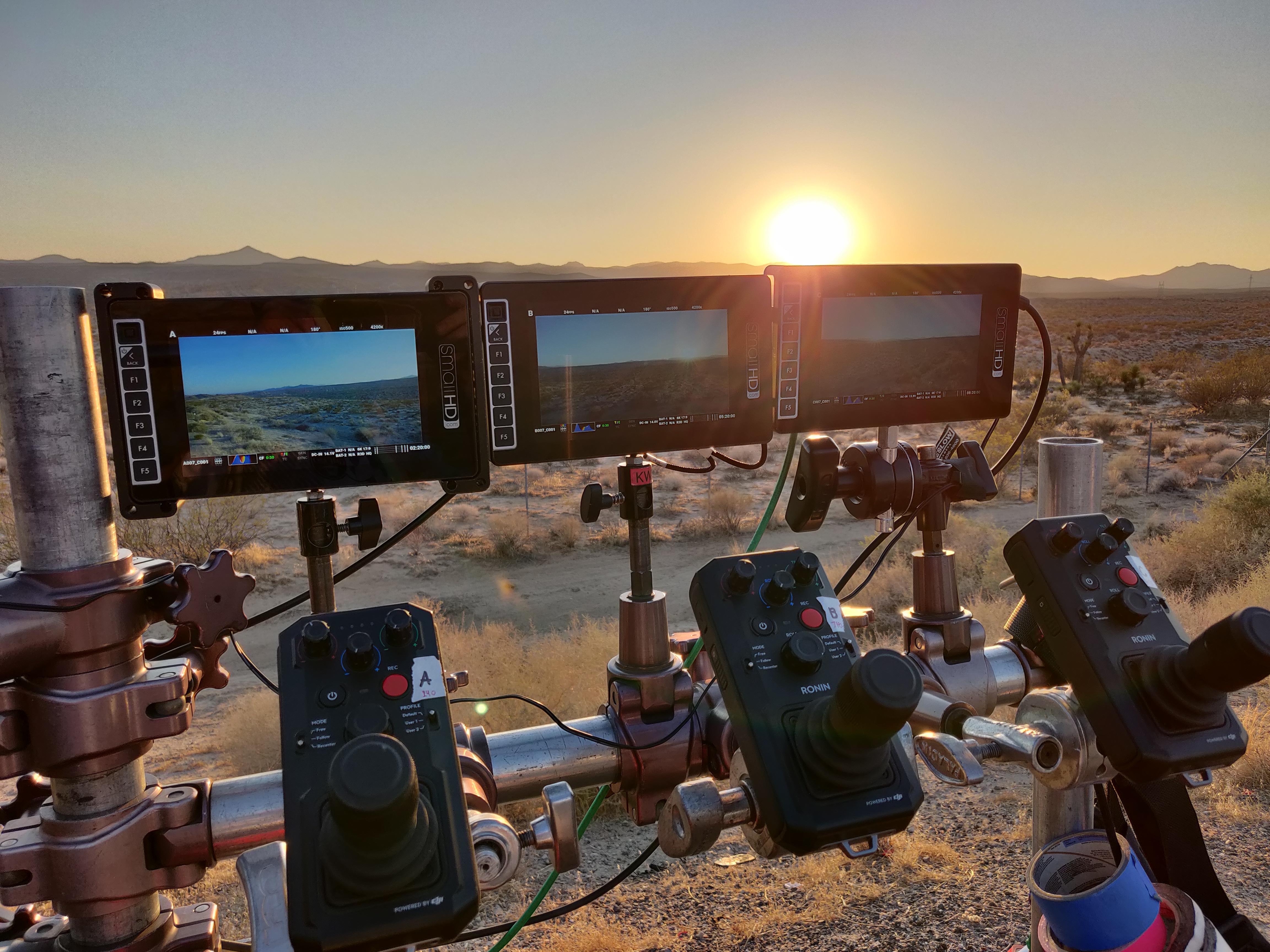
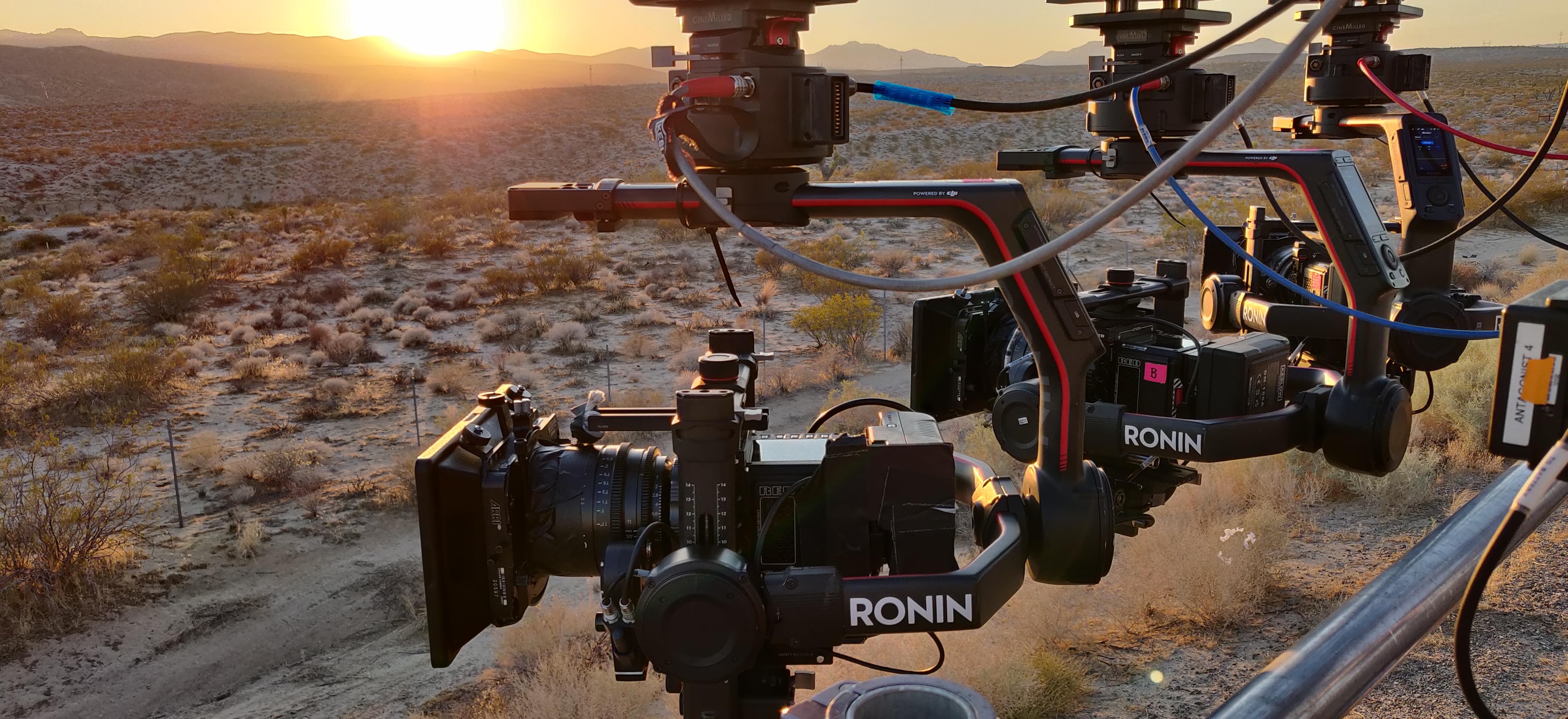
Seeing as how they would be train height and potentially see out of multiple windows on any given side of the train car, we shot with 3 RED Komodos on Ronins (for smoothness) with 14mm Sigma Art primes, which would cover a 180° field of view with enough overlap to stitch the cameras together. These were all built on a truck at train window height with the run/stop synchronized via a Tilta Nucleus. By setting the Nucleus motor on each camera to the same channel, a single handset could control the iris (which we wanted to match between cameras) and run/stop on all three units.


We shot a few locations for the show, some in the desert, some on the freeway between Glendale and Eagle Rock, and a bit near downtown.


We did discover that the Komodos don't like having their exhaust vent facing upwind, as the incoming air would fight against the fan blowing the opposite direction and create a sort of air-pressure stalemate, causing them to overheat quickly. We solved the issue by taking a small piece of foam board, folding it into a "V", and taping the "tent" over the the exhaust port, effectively keeping the upwind air from pushing against the fan, but letting the hot air vent out the top and bottom of the tents. After that, we had no temperature issues at all.


I haven't seen all of the new season, so haven't found where the downtown footage we shot has been used yet, but we did the desert background plates for these shots:


As well as the arrival of the train to the city, shot on the 134 going up and down the hill between Glendale and Eagle Rock, as seen in these shots:


It was a pretty fun shoot and interesting in that we shot these before the main unit had even started filming the show, whereas I'm used to us shooting either concurrent with the main unit or, for a lot of the network TV shows that shoot their cars on green screen, well after they've shot their episode.